
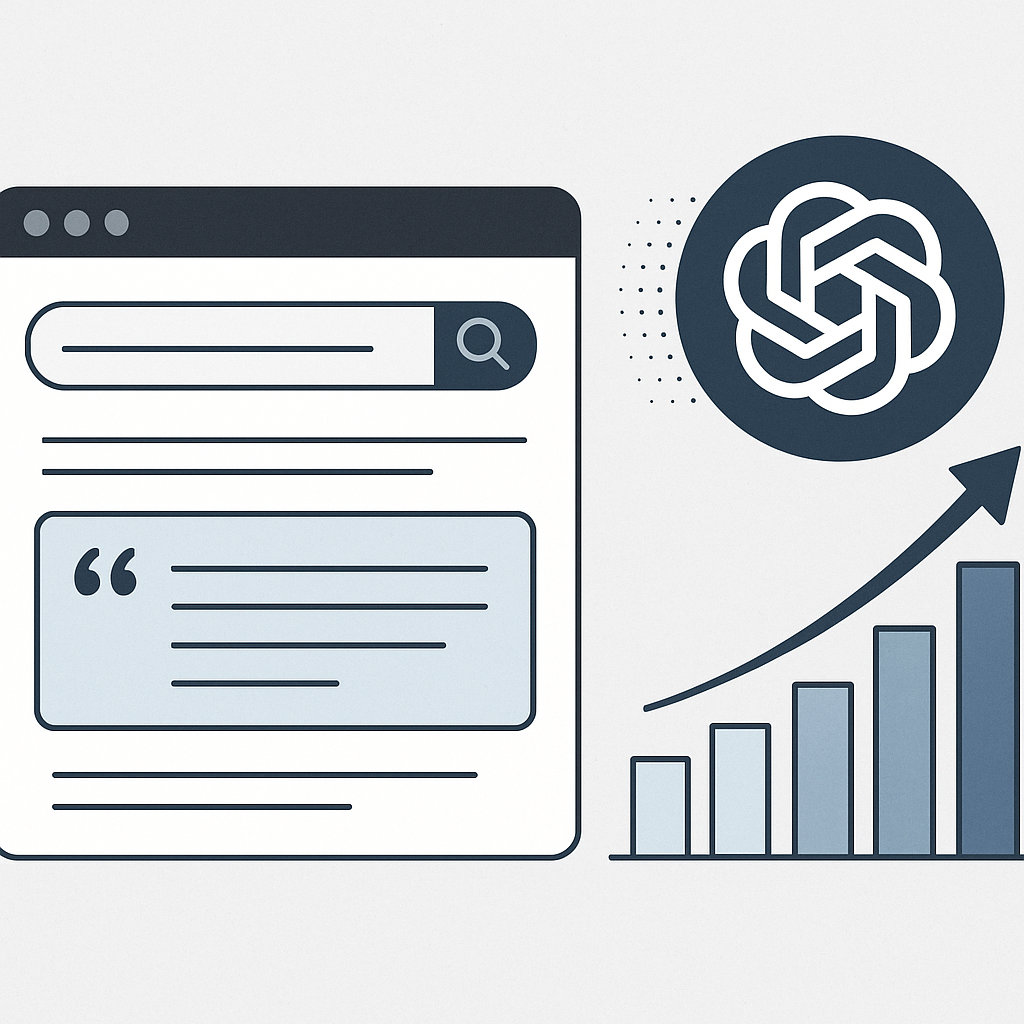
Generative Engine Optimization: How to Get Your Business Cited by ChatGPT, Not Just Ranked on Google
Google rankings are not the finish line anymore.
Right now, your potential customers are typing questions into ChatGPT, Perplexity, Google's AI Overviews, and Microsoft Copilot. Those tools are answering back — with specific business names, specific facts, and specific recommendations.
If your business isn't one of them, you're invisible to a growing slice of your market.
That's what generative engine optimization is about. Not replacing your SEO strategy. Extending it into the places where your customers are already going for answers.
This post breaks down what GEO is, why it matters for small businesses right now, and exactly what you need to do to get cited — not just ranked.
What Generative Engine Optimization Actually Means
Search engine optimization taught you to rank on a results page. A customer searches. Google shows ten blue links. You compete for position one.
Generative engine optimization is different. AI search tools don't show ten links. They synthesize an answer. They pull from sources they trust, summarize what they find, and present a confident response. Sometimes they cite a source. Sometimes they don't.
Your goal is to be the source they trust and cite.
That means the old rules — keyword density, backlinks, meta tags alone — aren't enough. AI models are trained on content that is clear, authoritative, well-structured, and genuinely useful. They favor businesses that sound like experts, not businesses that sound like they're writing for a search algorithm.
The shift is real. A 2023 study by BrightEdge found that AI-generated answers were appearing in a majority of Google searches in certain categories. Perplexity crossed 10 million daily queries in 2024. ChatGPT hit 100 million weekly users faster than any product in history.
Your customers are using these tools. The question is whether those tools know you exist.
Why Small Businesses Are Getting Left Out
Most small businesses have the same problem. Their website exists. They have a few service pages. Maybe a blog post or two from two years ago.
That's not enough to get cited by an AI model.
AI search tools look for specific signals. They look for consistent, detailed content across multiple topics. They look for mentions on third-party websites. They look for structured information — hours, locations, services, pricing ranges — that answers questions directly.
Generic service pages don't cut it. "We're a trusted local HVAC company serving the region" tells an AI model nothing it can use to recommend you.
Here's what that looks like in practice. Salmon HVAC came to Disruptors Media with a strong regional brand and a weak digital presence. Outdated website. Low organic visibility. Revenue plateaued between $80,000 and $100,000 per month.
We installed an AI SEO system that produced seasonal, keyword-specific content consistently. Not content written to stuff keywords — content written to answer the specific questions homeowners ask about heating and cooling. The kind of content an AI model can pull a direct answer from.
Website traffic went up 300%. Organic leads went up 214%. Revenue climbed past $250,000 per month.
That content doesn't just rank on Google. It becomes the kind of authoritative, answer-ready material that generative AI tools cite.
The Core Signals GEO Relies On
Getting cited by AI isn't magic. There are real, repeatable signals these models respond to. Here's what to focus on.
1. Answer-First Content Structure
AI models are built to answer questions. Your content should be too.
Write content that states the answer in the first sentence, then supports it. Use H2s and H3s that mirror the actual questions your customers ask. Include specific numbers, timeframes, and outcomes — not vague assurances.
If someone asks ChatGPT "How much does a panel upgrade cost in [city]?" and your electrical contracting website has a detailed, direct answer to that question, you have a real chance of being cited.
Bright Solutions, an electrical contractor we worked with, had no content strategy at all. High-ticket jobs — panel upgrades, EV charger installations — were treated the same as small repairs. Once we built systems to prioritize and communicate around those specific services, average ticket value rose from $840 to $1,190. High-value job volume went up 67%. Content that speaks directly to specific, high-value services is the same content AI models pull citations from.
2. Third-Party Mentions and Authority Signals
AI models don't just read your website. They read everything written about you.
Get mentioned in local business directories. Earn reviews on Google, Yelp, and industry-specific platforms. Get quoted in local press. Build your Google Business Profile out completely. These mentions are signals that tell AI systems you are a real, established business with a reputation — not just a website.
Ashley Buckner, a licensed therapist we worked with, used AI content systems to show up consistently across platforms. She tripled demand for her practice, doubled her prices, and grew to 30,000 Instagram followers in ten months. That kind of multi-platform presence is exactly what builds the authority signals AI models respond to.
3. Structured, Specific Information
AI models love specificity. Vague content gets ignored.
Add schema markup to your website. This tells search engines and AI crawlers exactly what your business does, where it operates, what it charges, and how to contact you. Include FAQ sections that mirror real customer questions. Publish detailed service pages that explain your process step by step.
SegPro Solutions had a large network but zero online visibility. We added services pages, sitemaps, and social proof to their website — structured information that AI crawlers could actually read and use. They scaled from $25,000 per month to over $120,000 per month in recurring revenue.
4. Topical Depth and Consistency
One blog post does not make you an authority. Fifty posts on topics loosely related to your business, published inconsistently, don't either.
Topical authority means owning a subject area. It means having detailed content that covers every angle of what your customers care about — from the basic questions to the complex ones. AI models favor sources that demonstrate deep, consistent expertise on a topic.
This is why an AI content system beats a one-off content push every time. Consistent output, built around what your customers actually search and ask, compounds over time.
GEO vs. Traditional SEO: What Changes, What Stays the Same
Generative engine optimization is not a replacement for traditional SEO. It's an extension.
You still need a fast, technically sound website. You still need relevant keywords. You still need backlinks. Google's traditional results page is still real, and rankings there still drive traffic.
What changes is the content strategy layer. Traditional SEO optimizes for clicks. AI search optimization optimizes for citations. You're writing to be the authoritative source an AI model trusts — not just the page a human chooses to click.
The businesses that are going to win the next five years are the ones that optimize for both. Rank on Google and get cited by ChatGPT. The ones that only focus on one are handing ground to whoever optimizes for the other.
What an AI SEO System Actually Looks Like
At Disruptors Media, we don't hand you a content calendar and wish you luck. We install AI systems inside your business that produce, publish, and optimize content consistently — without requiring you to be a writer or a marketer.
Here's the process:
- Audit — We identify the gaps between what your business does and what AI models currently know about you.
- Research — We analyze what your competitors are being cited for and where you can own territory they're ignoring.
- Build — We install an AI SEO content system inside your tech stack. You own it. It runs inside your accounts, not ours.
- Track and optimize — We monitor what's driving citations, leads, and revenue — and we adjust.
These are not templated blog posts. This is a system that understands your services, your geography, and your customers' questions — and answers those questions at scale.
When Apex Construction Group needed to grow beyond word-of-mouth referrals, we installed AI SEO and B2B systems that centralized their intake and built their authority online. Response time dropped from 31 hours to 8.5 hours. Bids submitted went up 29%. Win rate climbed from 18% to 26%. They signed $803,000 in new contracts.
That's what ai seo services look like when they're built inside the business, not rented from an agency.
The Ownership Question
Here's where most agency models fail.
An agency runs your content for you. They own the logins. They own the strategy. They own the system. The day you stop paying, the content stops and the system disappears.
That's not how Disruptors Media works.
Every system we build lives inside your business. Your accounts. Your tech stack. When we're done, you own an AI-powered content and SEO engine that keeps producing, keeps ranking, and keeps getting you cited — whether or not you're still writing checks to us.
That's the difference between renting visibility and owning it.
The Bottom Line
AI search is not coming. It's here.
ChatGPT, Perplexity, and Google's AI Overviews are already answering your customers' questions. They're already citing businesses by name. Your competitors are either in that answer or they're not.
Generative engine optimization is how you get in it.
It requires answer-first content. Topical authority. Structured data. Third-party mentions. Consistent output. All of it working together to tell AI models: this business knows what it's talking about, and it's the right answer to surface.
You don't need a bigger team to do this. You need the right systems installed in your business.
Ready to Get Cited?
Disruptors Media builds AI SEO and GEO systems inside your business. You own everything we install. We start with a free audit — we look at where you stand, where your competitors are, and what it would take to get you cited by the AI tools your customers are already using.
Book your free consultation at consult.disruptorsmedia.com or email kyle@disruptorsmedia.com.
The businesses that adapt early take the market. The ones that wait hand it to someone who didn't.