
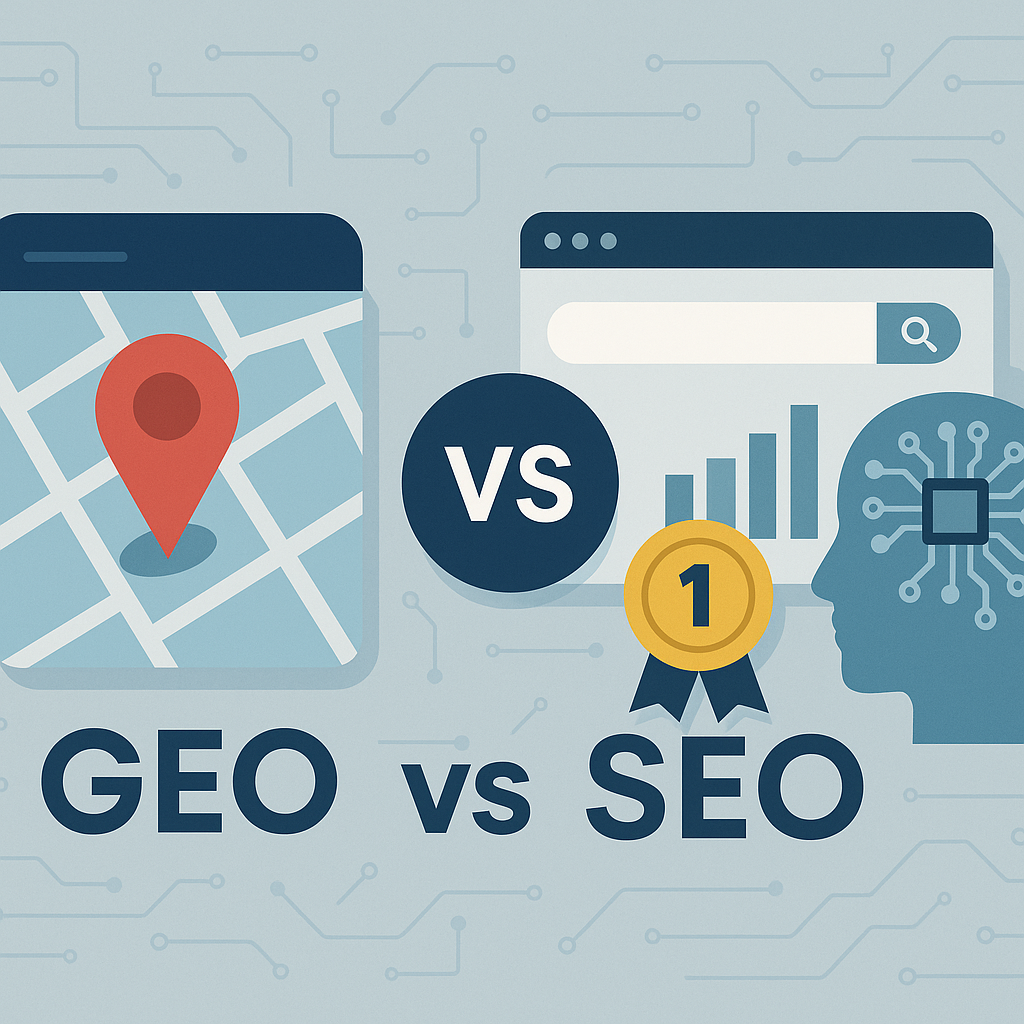
GEO vs SEO: Why Ranking #1 on Google Won't Save You in the AI Search Era
You worked hard for that #1 ranking. You earned it.
And it might not matter anymore.
That's not a prediction. That's what's already happening to small-business owners across every service industry. Google is changing the way it surfaces answers. AI tools like ChatGPT, Perplexity, and Google's own AI Overviews are answering questions directly — without sending users to any website at all.
If your entire growth strategy rests on SEO, you're building on shifting ground. Understanding the difference between GEO vs SEO isn't optional anymore. It's the business decision that separates the owners who grow in the next three years from the ones who quietly lose market share while wondering why their traffic is dropping.
What SEO Actually Does — and Where It Stops
Search engine optimization gets your website ranked in Google's blue-link results. You write the right content, build authority, earn backlinks, and over time Google surfaces your pages when someone types a relevant query.
That model worked brilliantly for 25 years. It still matters. But it was built for a specific behavior: a user types a query, Google returns a list of links, the user clicks through, and lands on your site.
AI search breaks that chain.
When someone asks ChatGPT "who's the best HVAC company in [city]" or asks Google's AI Overview "what should I budget for a kitchen remodel," they often get a complete answer on the spot. No list. No links. No click. No visit to your site.
Your #1 ranking doesn't exist in that exchange.
This isn't a fringe trend. AI-generated answers are becoming the default interface for search across every major platform. And the criteria an AI uses to surface a business or recommend a service is not the same criteria Google's traditional algorithm uses to rank a webpage.
GEO vs SEO: Understanding the Real Difference
SEO is about ranking web pages in traditional search engines. It's driven by keywords, backlinks, technical site health, and content volume. Success is measured in rankings and organic traffic.
GEO — generative engine optimization — is about getting your business cited, referenced, or recommended by AI-powered search tools. Instead of optimizing for an algorithm that ranks pages, you're optimizing for a language model that synthesizes information and presents answers.
The tactics are different. The success signals are different. And critically, the failure modes are different.
With SEO, if you drop in rankings, you still exist in the results — just lower. With AI search, if you haven't built the right signals, you simply don't appear. There's no page two. There's no "at least we're on the first page." There's an AI-generated answer that mentions your competitor by name, and you're not in it.
GEO is not a replacement for SEO. The strongest businesses will run both. But you cannot afford to ignore generative engine optimization while your competitors are already building for it.
Why This Hits Small Businesses Hardest
Enterprise brands have teams dedicated to staying ahead of platform shifts. They have content departments, SEO directors, and now AI strategists.
You have yourself, maybe a small team, and whatever marketing vendor you're currently paying.
Small-business owners in trades and services — HVAC, electrical, remodeling, chiropractic, construction — built their online presence around the traditional SEO playbook. Rank for local keywords. Optimize Google Business Profile. Run some paid ads.
That's not wrong. But it's no longer complete.
Here's the compounding problem: AI search tools pull their answers from a combination of structured data, authoritative content, reviews, citations, and brand mentions across the web. If your digital presence is thin — a few service pages, a basic website, and some Google reviews — you're invisible to AI systems.
The businesses that AI tools cite are the ones that have built genuine authority signals across multiple channels. That means real content that answers real questions. That means consistent mentions on credible platforms. That means a website that's structured so AI can actually understand and use what's on it.
Most small-business websites don't clear that bar yet. That's a window of opportunity — but only for the owners who move now.
What AI Search Optimization Actually Requires
AI search optimization isn't magic. It's the deliberate process of making your business easy for AI systems to understand, trust, and cite.
Here's what that looks like in practice.
Authoritative, structured content. AI tools favor content that directly and completely answers specific questions. That means moving beyond thin service pages into content that explains how things work, what things cost, what to look for, and how to decide. Depth signals authority.
Consistent entity signals. AI systems build a model of your business from everything they can find about you across the internet. Your name, location, services, specialties, and reputation need to be consistent everywhere — your website, your Google profile, directories, review sites, and social platforms. Inconsistency creates uncertainty. AI systems don't recommend businesses they're uncertain about.
Real reviews and real mentions. Reputation signals matter enormously in AI search. The volume, recency, and quality of your reviews influence whether an AI system treats your business as trustworthy. So do citations from credible third-party sources.
Structured data and technical clarity. Your website needs to speak the language AI systems use to categorize information. Schema markup, clear page structure, and unambiguous service descriptions help AI tools understand exactly what you do and who you serve.
Multi-channel presence. A business that appears across its website, social platforms, industry directories, and news mentions looks real and established to an AI system. A business with only one touchpoint looks thin.
None of this is separate from good SEO. In fact, the content and authority signals that power strong generative engine optimization are built on the same foundation as traditional SEO. The difference is intentionality. You're not just optimizing for keyword rankings anymore. You're building a business that AI systems trust enough to recommend.
What Salmon HVAC Learned the Hard Way — and Then Fixed
Salmon HVAC was a strong regional brand. Good reputation. Loyal customers. But their digital engine was weak. Outdated website, low organic visibility, and a marketing approach that wasn't keeping pace with how their customers were searching.
After installing an AI SEO content system — one that produced regular, structured, authoritative content about their services, service area, and seasonal needs — their website traffic grew by 300%. Organic leads grew by 214%.
That kind of growth doesn't come from chasing one channel. It comes from building an authoritative presence that traditional search and AI systems can find, understand, and trust.
Revenue went from $80,000–$100,000 per month to over $250,000 per month.
That's what happens when you stop renting visibility from a single algorithm and start building owned authority across channels.
The Ownership Difference
Here's the deeper issue with most small-business marketing.
You're renting your visibility. You rent your rankings from Google's algorithm. You rent your leads from paid ad platforms. The day the algorithm shifts — or the day a new search interface replaces the blue-link result — the rented visibility disappears.
The businesses that survive platform shifts are the ones that own real authority. They've built content that actually helps people. They've earned citations and reviews and mentions that AI systems can verify. They've created a presence that's bigger than any single platform's current ranking system.
That's the frame for thinking about GEO vs SEO. It's not a choice between two tactics. It's a decision about whether you're building something you own or renting something that can be taken away.
At Disruptors Media, we build AI systems for content, SEO, and generative engine optimization inside your business — so you own the authority engine, not just the current-month ranking.
We start with an audit. We identify where your visibility is thin and where your competitors are already building AI-ready authority signals. Then we install the systems that produce consistent, structured content and build the presence that AI tools recognize.
When we're done, those systems live inside your business. You own them. You run them.
The Window Is Open — But Not Indefinitely
The businesses getting cited by AI search tools three years from now are starting to build that authority today. Not because they had a crystal ball. Because they recognized that the platform was shifting and they moved before the shift was complete.
The good news: most of your local competitors haven't started yet. The gap between businesses with AI-ready authority and businesses still running a 2019 SEO playbook is growing fast. Getting started now is still an early-mover decision.
The less good news: that window closes. AI search is not a future consideration. It's the present reality of how your potential customers are finding and evaluating service providers.
Ranking #1 on Google is not enough. You need to be the business that AI recommends.
Ready to find out where your AI-search authority stands? Book a free consultation at consult.disruptorsmedia.com or email kyle@disruptorsmedia.com. We'll audit your current presence, map the gaps, and show you exactly what to build — and you'll own every piece of it.