
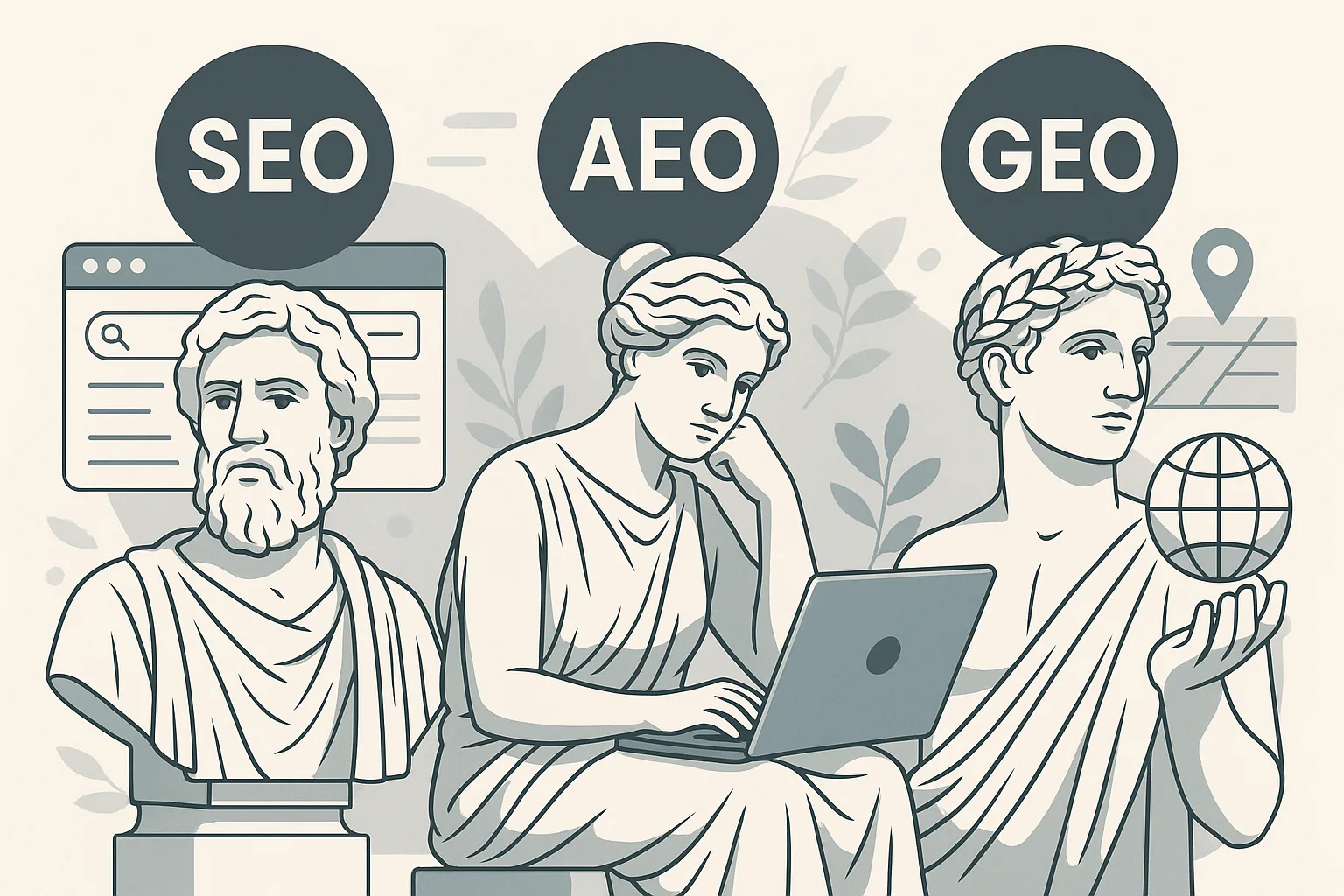
What is the Difference Between SEO, AEO, and GEO?
Understanding the digital landscape can be daunting for business owners and contractors. Among the key terms that often come up are SEO, AEO, and GEO. Each of these acronyms represents a different approach to online visibility and audience engagement. In this blog post, we’ll break down what each term means, how they differ, and why they matter for your business. By the end, you’ll have a clearer picture of how to leverage these strategies to enhance your online presence and connect with your target audience effectively.
What is SEO?
Search Engine Optimization (SEO) is the process of optimizing your website to rank higher in search engine results pages (SERPs). It involves various techniques, including keyword research, on-page optimization, technical SEO, and link building. The primary goal of SEO is to increase organic traffic to your website by making it more attractive to search engines like Google.
For example, if you run a landscaping business, using SEO strategies might involve optimizing your website content with relevant keywords like "landscaping services in [Your City]." By doing so, you can improve your chances of appearing at the top of search results when potential customers search for those services.
Actionable Tips:
- Conduct keyword research to identify terms your target audience is searching for.
- Optimize your website's content and meta tags with those keywords.
- Build backlinks from reputable sites to increase your site's authority.
What is AEO?
Answer Engine Optimization (AEO) focuses on optimizing content for voice search and direct answers that search engines provide. With the rise of virtual assistants like Siri and Alexa, users are increasingly looking for quick answers rather than browsing through multiple links. AEO aims to ensure your content is featured in these direct answer formats, such as featured snippets or knowledge panels.
For instance, if someone asks their voice assistant, "What are the best plants for indoor gardening?" AEO strategies would ensure that your website appears as the authoritative source for that information, driving traffic directly to your page.
Actionable Tips:
- Structure your content to answer common questions directly, using clear headings and bullet points.
- Use schema markup to help search engines understand the context of your content.
- Focus on creating concise, informative answers that can be easily pulled by search engines.
What is GEO?
Geographic Optimization (GEO) is about tailoring your online presence to attract local customers. This is particularly important for businesses that rely on foot traffic or local clientele, such as restaurants, retail stores, and service providers. GEO strategies involve optimizing your website and online profiles for local search terms and ensuring your business appears in local directories and maps.
For example, if you own a plumbing business in North Salt Lake, you would want to optimize your website for keywords like "plumbing services in North Salt Lake" and ensure your Google My Business profile is fully optimized with your location, hours, and customer reviews.
Actionable Tips:
- Claim and optimize your Google My Business listing with accurate information.
- Use local keywords throughout your website and in your content.
- Encourage satisfied customers to leave positive reviews on local directories.
How SEO, AEO, and GEO Work Together
While SEO, AEO, and GEO each have distinct focuses, they are interconnected and can complement each other. A well-rounded digital marketing strategy should incorporate elements of all three to maximize reach and engagement.
For instance, a local business can use SEO to rank for general keywords, AEO to capture voice search traffic, and GEO to ensure they are visible to local customers. By integrating these strategies, businesses can create a robust online presence that meets the varied needs of their audience.
Actionable Tips:
- Conduct an audit of your current digital marketing strategy to identify areas for improvement in SEO, AEO, and GEO.
- Create a content calendar that includes topics for local SEO, voice search optimization, and general SEO.
- Monitor your analytics to see which strategies are driving traffic and adjust your approach based on performance.
Common Misconceptions About SEO, AEO, and GEO
There are several misconceptions surrounding these terms that can lead to confusion for business owners. One common myth is that SEO alone is sufficient for online success. In reality, as search engines evolve, incorporating AEO and GEO strategies is becoming increasingly important.
Another misconception is that AEO is only relevant for large brands. In fact, small businesses can benefit significantly from optimizing for voice search, as it allows them to compete for attention in a rapidly changing digital landscape.
Actionable Tips:
- Educate your team on the differences between SEO, AEO, and GEO to ensure everyone is on the same page.
- Stay updated on industry trends and changes in search engine algorithms that may affect your strategies.
- Consider consulting with a marketing agency to develop a comprehensive strategy that includes all three components.
The Future of SEO, AEO, and GEO
As technology continues to evolve, so too will the strategies surrounding SEO, AEO, and GEO. With the rise of artificial intelligence and machine learning, search engines are becoming better at understanding user intent and context. This means businesses will need to adapt their strategies accordingly.
For example, businesses may need to focus more on creating high-quality content that addresses user needs rather than simply optimizing for keywords. Additionally, as voice search becomes more prevalent, businesses will need to tailor their content to fit conversational queries.
Actionable Tips:
- Invest in training for your team to stay ahead of emerging trends in digital marketing.
- Experiment with new content formats, such as video or interactive content, to engage users.
- Regularly review and update your SEO, AEO, and GEO strategies to keep pace with changes in the digital landscape.
Frequently Asked Questions
What is the main goal of SEO?
The main goal of SEO is to increase organic traffic to your website by optimizing it for search engines, ensuring that it ranks higher in search results for relevant keywords.
How does AEO differ from SEO?
AEO focuses specifically on optimizing content for voice search and direct answers provided by search engines, while SEO encompasses a broader range of techniques aimed at improving overall search engine rankings.
Why is GEO important for my business?
GEO is crucial for businesses that rely on local customers, as it helps ensure that your business appears in local search results and directories, driving foot traffic and local engagement.
Can I use SEO, AEO, and GEO together?
Yes, integrating SEO, AEO, and GEO strategies can create a comprehensive digital marketing approach that maximizes your online visibility and engagement with your target audience.
How can I get started with optimizing for AEO?
To optimize for AEO, focus on creating clear, concise answers to common questions, use structured data markup, and ensure your content is easily accessible for search engines to pull direct answers.
In conclusion, understanding the differences between SEO, AEO, and GEO is essential for any business looking to enhance its online presence. By leveraging these strategies effectively, you can connect with your target audience, drive traffic to your website, and ultimately grow your business. If you’re ready to take your digital marketing to the next level, request a consultation with Disruptors Media today. We’re here to help you navigate the complexities of online marketing and develop a tailored strategy that works for you.